Is your water heater trying to tell you something? Most water heaters don’t fail without warning. They give off signals—sometimes for weeks or months—before giving up entirely. Knowing these warning signs can save you from waking up to a cold shower or, worse, coming home to a flooded basement.
Here are seven signs that your water heater is nearing the end of its life—and what you can do about each one.
1. Your Water Isn’t as Hot as It Used to Be
If you’ve noticed the water isn’t getting as hot, or runs out faster than it used to, your water heater is struggling. This is often caused by:
- Sediment buildup at the bottom of the tank, which insulates the water from the heating element
- A failing heating element (in electric heaters) or burner issues (in gas heaters)
- A faulty thermostat that’s no longer reading temperature correctly
What to do:
A plumber can flush the tank to remove sediment or diagnose component failures. If your heater is under 8 years old, repair is usually worthwhile. If it’s older, replacement may be more cost-effective.
2. Rusty or Discolored Hot Water
When only your hot water is rusty or brown, the problem is likely inside your water heater—not your pipes. The steel tank is corroding from the inside, and rust particles are making their way into your water supply.
If both hot and cold water are discolored, the issue is more likely in your supply lines or municipal water. But if it’s only the hot water, your tank is rusting.
Why this matters:
A rusting tank will eventually leak. Once corrosion starts, it’s usually a matter of when, not if, the tank will fail. It’s time to start planning for replacement.
3. Strange Noises from the Tank
Water heaters should operate quietly. If you’re hearing rumbling, popping, cracking, or banging sounds, sediment has likely hardened at the bottom of the tank. When the burner heats the water, it has to work through that layer of sediment, creating these noises.
The problem: that extra effort wears out the tank faster and wastes energy.
What to do:
Annual flushing can prevent sediment buildup. If noises have already started, flushing may help—or it may reveal that the damage is done and replacement is needed.
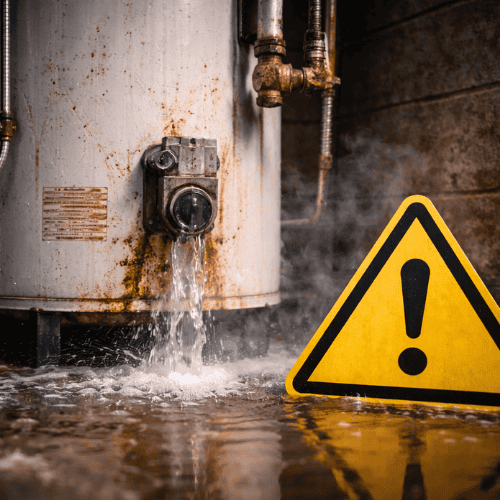
4. Water Pooling Around the Base
Any water around your water heater demands immediate attention. Check for:
- Loose fittings at the inlet, outlet, or T&P valve
- A leaking T&P (temperature and pressure) valve—this safety device may be doing its job or may need replacement
- Tank leaks—if the tank itself is leaking, replacement is the only option
Tank leaks happen when internal corrosion finally eats through the steel. There’s no repair for a leaking tank—only replacement.
4. Water Pooling Around the Base
Most tank water heaters last 10-15 years. If yours is in that range—or you don’t know its age—it’s time to start planning.
How to find the age: Look at the serial number on the manufacturer’s sticker. Most manufacturers encode the date in the first few characters. A quick search for your brand’s date code will tell you when it was made.
Even if an older heater is still working, efficiency drops over time. A new water heater could significantly reduce your energy bills.
6. Frequent Repairs
If you’ve called a plumber for water heater repairs more than once in the past year, it’s time to consider the math. Repair costs add up, and each fix is just buying time on an aging system.
The general rule: If a repair costs more than 50% of replacement cost, and your heater is over 8 years old, replacement is usually the smarter investment.
7. Inconsistent Water Temperature
Does your water temperature fluctuate without anyone adjusting it? One shower is scalding, the next is lukewarm? This inconsistency usually indicates:
- Thermostat problems
- Heating element failure (electric heaters)
- Sediment interfering with heat transfer
Inconsistent temperature isn’t just annoying—it can be a safety issue, particularly if water suddenly becomes hot enough to scald.
What Should You Do Now?
f you’ve noticed one or more of these signs, don’t wait for a complete failure. A proactive replacement on your schedule is always better than an emergency replacement on a Saturday night.
Our water heater installation team can assess your current unit, explain your options—tank, tankless, or hybrid—and provide a clear estimate with no pressure.
If you’re in Salem, Beverly, Peabody, or anywhere on the North Shore, we offer same-day water heater assessments. And if yours does fail unexpectedly, we provide 24/7 emergency service.