
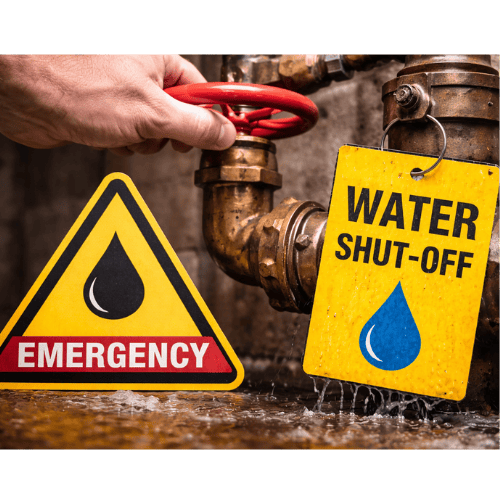
When a pipe bursts or a major leak starts, the first thing you need to do is shut off the water. Every minute water keeps flowing, the damage gets worse. Knowing where your shut-off valves are—and how to use them—can save you thousands in water damage repairs.
Here’s exactly how to stop the water, whether you need to shut off one fixture or your entire house.
Where Is Your Main Water Shut-Off Valve?
Every home has a main shut-off valve that controls all water entering the house. In Massachusetts homes, it’s typically located in one of these places:
- Basement: Near the front foundation wall, close to the water meter
- Crawl space: Along the wall facing the street
- Utility closet: In homes without basements, check first-floor utility areas
- Near the water heater: The main line often runs near the water heater location
The valve is usually within a few feet of where the main water line enters your home from the street.
Pro tip: Find your shut-off valve now before you need it. Tag it with a label or bright tape so anyone in your household can locate it quickly in an emergency.
Types of Shut-Off Valves
You’ll encounter two main types of shut-off valves:
Gate valve: A round handle that looks like a wheel. Turn it clockwise (righty-tighty) to close. These older valves may require several full turns and can be stiff if they haven’t been used in years.
Ball valve: A lever handle that moves 90 degrees. When the lever is parallel to the pipe, water flows. When it’s perpendicular (crosswise), water is off. These are faster to operate and more reliable than gate valves.
How to Shut Off Water: Step by Step
1. Locate the main shut-off valve
Check the basement, crawl space, or utility area near where the water line enters your home.
2. Turn the valve clockwise (gate valve) or perpendicular to the pipe (ball valve)
If it’s a gate valve, keep turning until it stops. Don’t force it if it’s completely stuck.
3. Open a faucet to confirm water is off
Turn on a faucet at the lowest point in your home. Some water will drain out, then it should stop.
4. Turn off your water heater
With no water flowing in, your water heater can overheat. Turn off the gas or flip the circuit breaker for electric heaters.
5. Call a plumber
Once the water is off and the immediate crisis is controlled, call for professional help.
Shutting Off Individual Fixtures
Not every situation requires shutting off the whole house. Most fixtures have their own shut-off valves:
- Toilets: Oval or football-shaped valve behind the toilet, near the floor
- Sinks: Valves under the sink, inside the cabinet (usually two—one for hot, one for cold)
- Washing machines: Two valves behind the machine for hot and cold supply
- Dishwashers: Usually under the kitchen sink or in an adjacent cabinet
For a toilet overflow or a leaking faucet supply line, shutting off the individual fixture is faster and keeps water running to the rest of your home.
What If the Valve Won’t Turn?
Old gate valves can seize up if they haven’t been used in years. If your valve won’t budge:
- Don’t force it—you could break the valve or the pipe
- Try a valve wrench or pliers wrapped in cloth to protect the finish
- Apply penetrating oil and wait a few minutes if you have time
- Call us immediately—we can shut off water at the street if needed
The Street Shut-Off Valve
If your main valve fails, there’s another shut-off at the street—usually in a covered box near the curb marked “WATER.” This valve requires a special tool (a curb key) and is technically the property of the water utility. However, in an emergency, anyone can use it.
We carry curb keys on our trucks and can shut off water at the street if your interior valve isn’t working.
After the Emergency
Once the water is off and you’ve called for help, take these steps:
- Document the damage—take photos and videos for insurance
- Move valuables away from affected areas
- Don’t walk through standing water if electrical outlets could be submerged
- Start drying things out if you can do so safely—fans and open windows help
Our emergency plumbing team serves Salem and the entire North Shore 24/7. When a pipe bursts at 2 AM, we answer the phone.