Tankless water heaters have been around long enough that the hype has settled. We install them regularly on the North Shore—and we also still install traditional tank heaters when that’s the better call. So when homeowners ask us “are tankless water heaters good?”, we give them the honest answer rather than a sales pitch.
The short answer: yes, tankless water heaters are good—often excellent—for the right home and the right household. But there are real trade-offs, and some North Shore homes have specific factors that affect how well they perform. Here’s what you need to know before making the switch.
How a Tankless Water Heater Actually Works
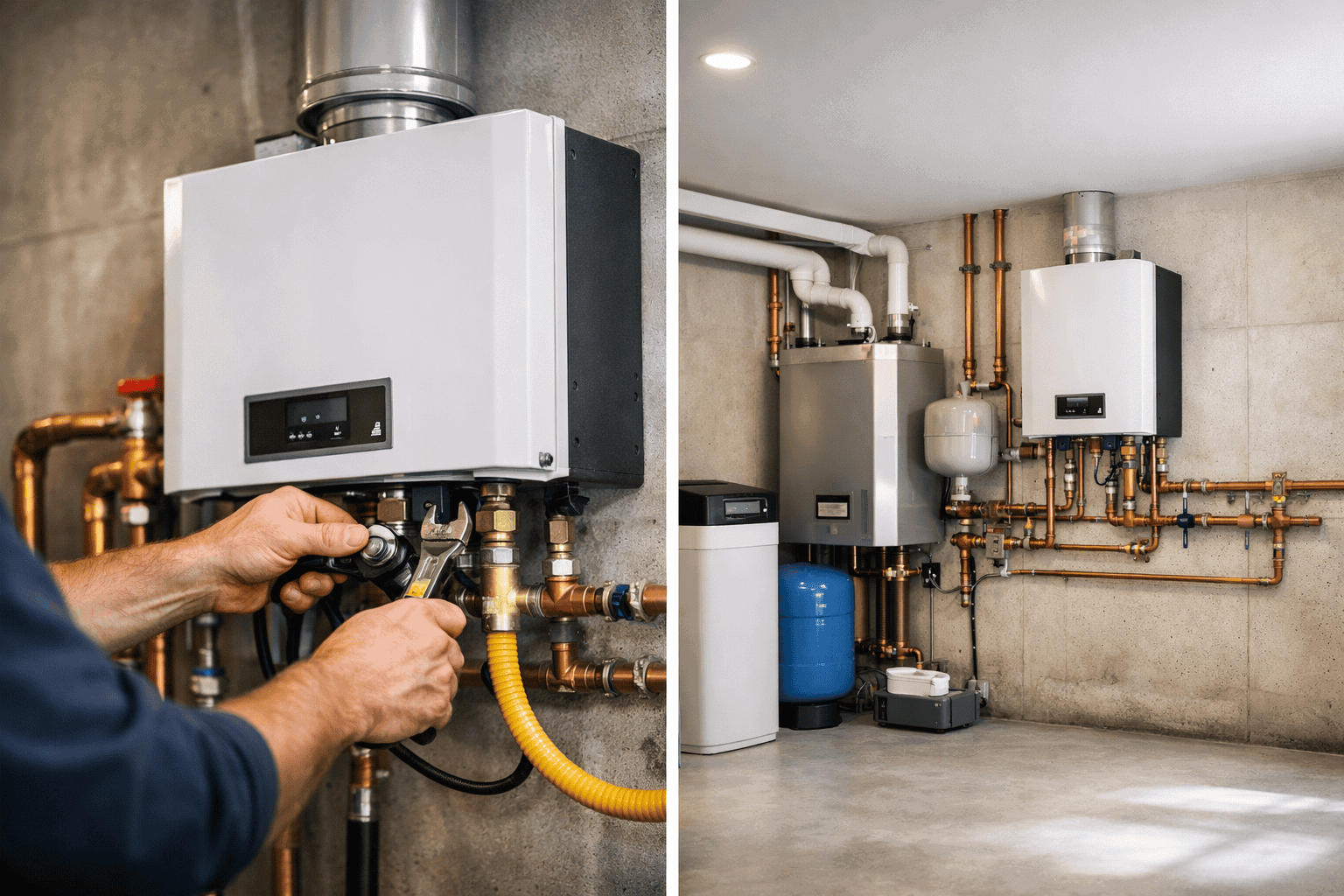
A traditional tank water heater stores 40–80 gallons of hot water and keeps it heated around the clock, whether you need it or not. A tankless unit does the opposite: it heats water on demand, only when you open a tap. Cold water flows through a heat exchanger—powered by gas or electricity—and exits hot within seconds.
The result is an effectively unlimited supply of hot water as long as demand doesn’t exceed the unit’s flow rate. No tank. No standby heat loss. No running out mid-shower.
The Real Benefits — What Makes Tankless Good
Energy Efficiency
This is the headline benefit, and it’s real. The U.S. Department of Energy reports that tankless water heaters are 24–34% more energy efficient than storage tank heaters for homes using around 41 gallons of hot water per day. Even in homes with higher usage, efficiency gains of 8–14% are typical.
The reason: no standby heat loss. A tank heater burns energy 24 hours a day keeping water hot. A tankless unit only fires when you need hot water. Over a New England heating season—where you’re running hot water for showers, dishes, and laundry through long cold months—that difference adds up.
Longer Lifespan
A traditional tank water heater typically lasts 10–13 years. A tankless unit, properly maintained, lasts 20 years or longer. For a homeowner in Salem or Beverly planning to stay in their house, that’s potentially one fewer replacement over the lifetime of the home—and the long-term math often favors tankless even with the higher upfront cost.
Space Savings
Tankless units mount to a wall and are roughly the size of a small suitcase. For older North Shore homes with tight mechanical rooms, basements shared with laundry and HVAC equipment, or homes converting utility closets, the space savings are meaningful.
Endless Hot Water
With a properly sized unit, you genuinely cannot run out of hot water. For households with multiple people, back-to-back showers, or frequent laundry and dishwasher use, this is a real quality-of-life upgrade.
The Trade-offs — What to Know Before You Switch
Higher Upfront Cost
This is the biggest objection, and it’s legitimate. A traditional 50-gallon gas water heater installed runs $1,200–$1,800 in the North Shore area. A gas tankless unit installed typically runs $3,000–$5,500, depending on the unit and whether gas line or venting work is needed. The payback period through energy savings is real but takes years—typically 7–12 years depending on your household’s usage.
That said, Mass Save rebates (more on those below) can meaningfully close that gap upfront.
Older Homes May Need Upgrades
This is particularly relevant on the North Shore, where the housing stock skews older. Gas tankless units require larger gas supply lines than traditional tank heaters—often ¾” or 1″ lines rather than the ½” line feeding an older tank. If your home doesn’t have adequate gas line capacity, that’s an additional cost.
Electric tankless units draw significant amperage and often require panel upgrades in homes with older electrical systems—common in pre-1970s Salem, Beverly, and Marblehead homes. We always assess this before quoting a job.
Cold Groundwater Temperatures in New England
This is something generic guides don’t mention but matters here. Groundwater temperatures in Massachusetts average 47–52°F, compared to 60–70°F in the South. Tankless units have to work harder to raise that colder incoming water to your target temperature, which affects flow rate. A unit rated for a Southern climate may underperform in New England without proper sizing. We size every unit for local groundwater temperatures.
Hard Water and Annual Maintenance
Parts of Essex County have moderately hard water. Mineral buildup inside a tankless heat exchanger reduces efficiency and can cause premature failure. Annual flushing with a descaling solution is not optional—it’s required maintenance. It takes about an hour and is straightforward, but it’s a commitment that traditional tank owners don’t have in the same way.
Modern high-efficiency condensing boilers operate at 90–95%+ AFUE versus the 80–85% typical of older units. Massachusetts homeowners can also receive rebates through Mass Save for qualifying high-efficiency boiler replacements—significantly offsetting the upfront cost. We can walk you through what’s currently available when we come out for an assessment.
Mass Save Rebates: A Major Factor for Massachusetts Homeowners
Massachusetts homeowners have access to rebates through the Mass Save program for qualifying high-efficiency water heaters. For gas tankless units meeting minimum Uniform Energy Factor (UEF) requirements, rebates are available that can meaningfully reduce the upfront cost of installation.
Rebate amounts vary depending on your utility provider (Eversource, National Grid, etc.) and the specific equipment installed. We handle the rebate paperwork as part of our installation process—you shouldn’t have to chase it down yourself. When we quote a tankless installation, we’ll tell you exactly what rebate you qualify for and factor it into the total cost comparison.
Who Should Switch to Tankless — and Who Shouldn’t
Tankless is a good fit if:
- You plan to stay in the home 8+ years (gives time for payback)
- You frequently run out of hot water or have high simultaneous demand
- You’re replacing a failed tank and open to a longer-term investment
- You have adequate gas supply or are doing other renovations that make upgrades practical
- You want to take advantage of Mass Save rebates while they’re available
Stick with a traditional tank if:
- You’re planning to sell within a few years — the payback window is too short
- Your home has significant gas line or electrical limitations and the upgrade cost makes the math unfavorable
- Your household’s hot water demand is low (single occupant, low usage) — the efficiency gains won’t be significant
- Budget is tight right now — a quality tank heater installed is a solid, reliable option
Frequently Asked Questions
Are tankless water heaters good for Massachusetts homes?
How much does a tankless water heater cost to install in Salem, MA?
What are the disadvantages of a tankless water heater?
Does Mass Save cover tankless water heater rebates in Massachusetts?
Talk to a Licensed North Shore Plumber Before You Decide
The right water heater depends on your home, your household size, your gas and electrical setup, and your plans for the property. We’ve installed both tank and tankless systems throughout Salem, Beverly, Peabody, Marblehead, Danvers, and the surrounding North Shore—and we’ll give you a straight recommendation based on your actual situation, not a one-size-fits-all answer.
Our water heater installation team can assess your home, walk you through the cost comparison including available Mass Save rebates, and get you a clear estimate. Call us at (978) 587-2073 or schedule online. If your current water heater has failed, we offer 24/7 emergency service.