Your boiler has been making a noise you’ve never heard before. Or maybe it’s heating some rooms but not others. Or your gas bill has crept up every winter for the past three years and you’re not sure why.
The question most North Shore homeowners eventually face: is it worth fixing, or is it time to move on?
There’s no single right answer—it depends on your boiler’s age, repair history, what the repair actually costs, and what a replacement would save you in energy bills. But there is a clear framework for thinking it through. Here’s how we walk homeowners through this decision every day.
Start With the Age of Your Boiler
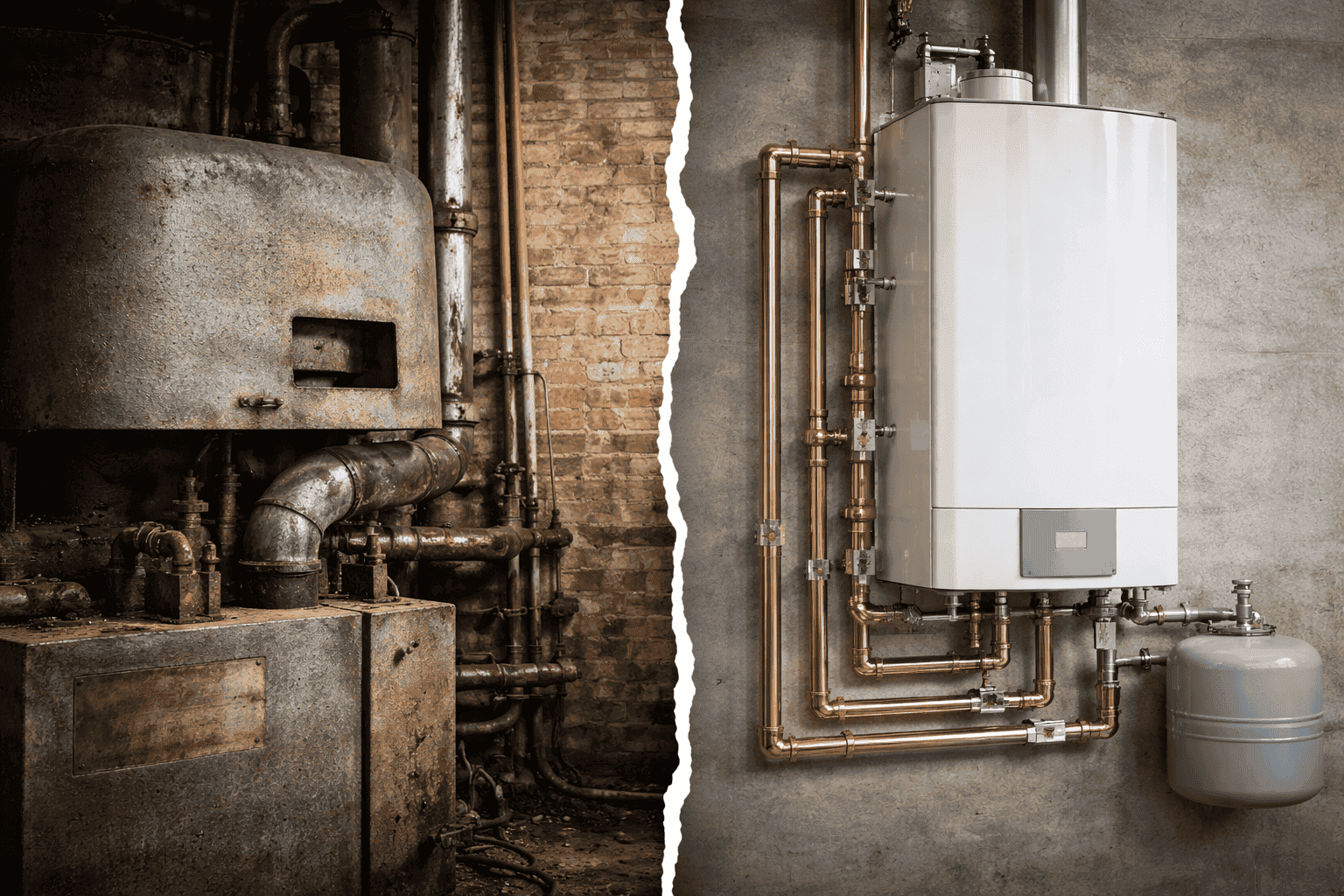
Age is the single biggest factor in the repair-vs-replace decision. Most cast iron boilers last 20–30 years with proper maintenance. Steel boilers typically run 15–25 years. If your boiler is within that range and well-maintained, repair is often the right call. If it’s past it—or close—every repair you make is buying time on a system that’s already lived its life.
To find your boiler’s age, look for the manufacturer’s label on the front or side of the unit. The serial number typically encodes the manufacture date—a quick search for your brand’s date code will tell you exactly when it was made.
The 50% Rule: A Simple Starting Point
The most widely used rule of thumb in the HVAC industry: if a repair costs more than 50% of what a new boiler would cost, and your unit is more than halfway through its expected lifespan, replacement is usually the smarter investment.
A simpler version: multiply your boiler’s age by the estimated repair cost. If that number exceeds $5,000, replacement is generally worth considering. A $400 repair on a 10-year-old boiler? Fix it. A $1,200 repair on a 25-year-old boiler? That math points toward replacement.
Repairs That Are Almost Always Worth Doing
If your boiler is under 15 years old and in good shape overall, these repairs are generally worth making:
- Thermocouple or thermostat replacement — usually under $300
- Circulator pump replacement — typically $300–$600
- Zone valve repair or replacement — usually $200–$400 per zone
- Pressure relief valve replacement — a safety device; replace if leaking
- Expansion tank replacement — typically $200–$400
- Bleeding radiators — if some rooms aren’t heating, start here
- Igniter or pilot light issues — straightforward fix on an otherwise healthy boiler
Warning Signs That Point Toward Replacement
Some problems indicate deterioration that a single repair won’t solve:
Visible Corrosion or Rust
Active corrosion—flaking, pitting, or rust streaks around joints—means the metal is deteriorating. A corroding boiler is heading toward a leak, and there’s no repair that reverses that process.
Cracks in the Heat Exchanger
The heat exchanger separates combustion gases from your home’s air. A cracked heat exchanger can allow carbon monoxide to enter your living space—a safety issue, not just an efficiency issue. Heat exchanger replacement often costs nearly as much as a new boiler.
Repairs Every Heating Season
One repair is normal maintenance. Two in a year on an aging boiler is a pattern. The cumulative cost—plus the risk of a failure on the coldest night of the year—usually makes replacement the better call.
Rising Energy Bills
A boiler 15–20 years old may be running at 70–75% AFUE. A new high-efficiency condensing boiler operates at 95%+. Over a full Massachusetts heating season, that gap can translate to $300–$600 a year in wasted energy costs.
Parts No Longer Available
If you’re waiting weeks for parts or paying premium prices to source them, replacement often makes more practical sense regardless of the repair cost itself.
Mass Save Rebates and Efficiency Savings
Modern high-efficiency condensing boilers operate at 90–95%+ AFUE versus the 80–85% typical of older units. Massachusetts homeowners can also receive rebates through Mass Save for qualifying high-efficiency boiler replacements—significantly offsetting the upfront cost. We can walk you through what’s currently available when we come out for an assessment.
How We Approach the Decision
- We diagnose the actual problem first. We won’t recommend replacement just because a boiler is old.
- We tell you the boiler’s age and overall condition. If we see other warning signs, we’ll tell you honestly.
- We give you both numbers. Here’s what the repair costs. Here’s what a replacement costs and what it would likely save you. The decision is yours.
- We don’t push replacement when repair makes sense. A young boiler with a straightforward fix doesn’t need to be replaced.
Frequently Asked Questions
How do I know if my boiler needs to be replaced?
How much does it cost to replace a boiler in Massachusetts?
What is the 50% rule for boiler repair?
Are there rebates for replacing a boiler in Massachusetts?
When to Call Us
If your boiler is making unfamiliar noises, cycling on and off more than usual, producing uneven heat, showing visible signs of wear, or your heating bills have been trending upward—it’s worth having a licensed plumber take a look before it gets worse.
Our boiler repair and installation team serves Salem, Beverly, Peabody, Marblehead, Danvers, and the surrounding North Shore. Call us at (978) 587-2073 or schedule a service call online. For heating emergencies, we’re available 24/7.